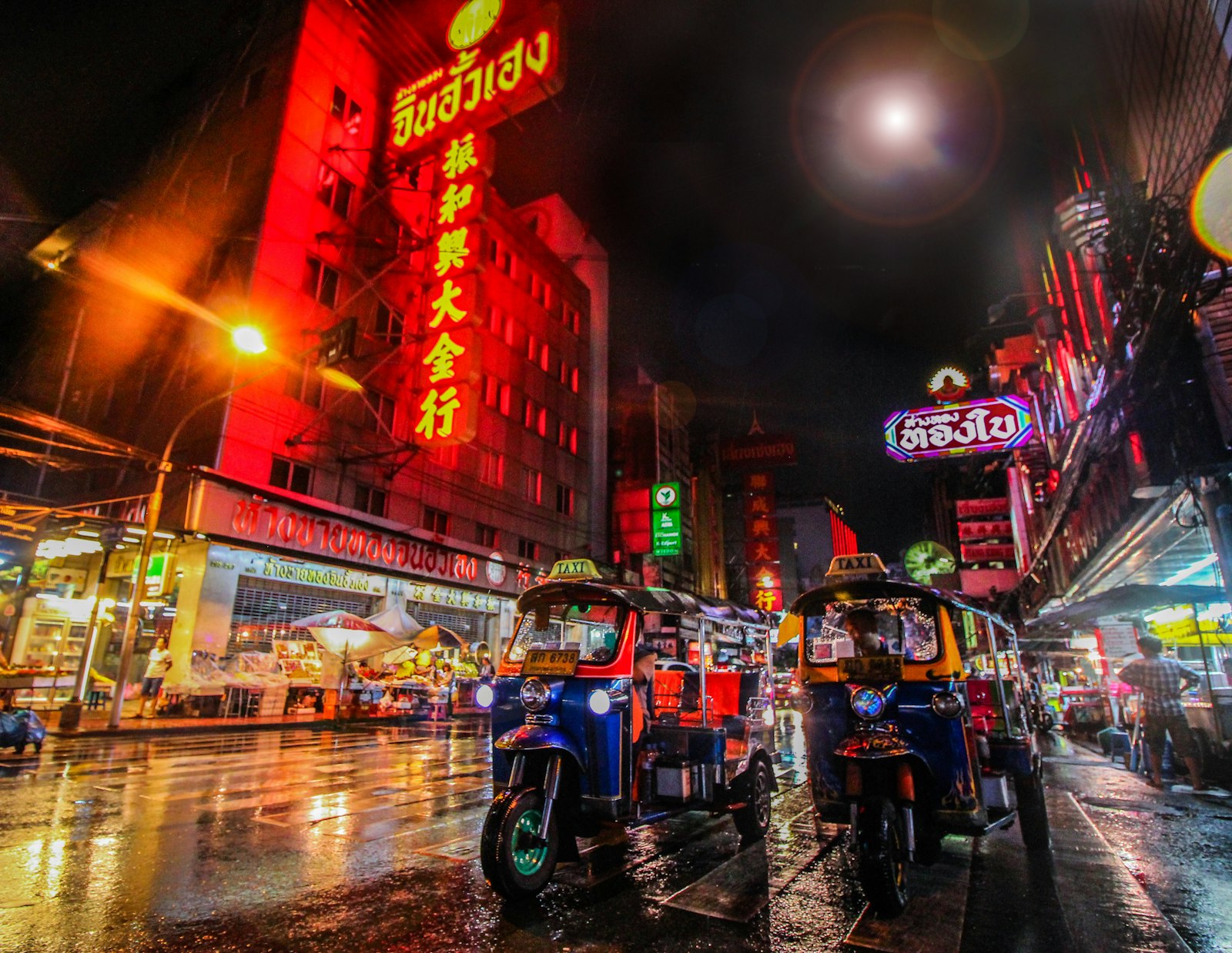
Walk down Sukhumvit on a Friday at seven in the evening and the crowd looks the way it has always looked: too many of everyone, all moving at slightly different speeds, motorbikes threading the foot traffic, a smell of grilled pork and exhaust. Look closer, at the wrists and the inner forearms and the napes of the necks, and the picture has shifted.
Ten years ago, the visible tattoos in this crowd were one of two kinds. The first were the sak yant, the sacred yantra tattoos given by Buddhist monks and lay masters: hard black geometry, Khom script, lines of protective inscription on the upper back or the chest. The second were Western-influenced colour pieces from the studios that catered to tourists: koi sleeves, tribal armbands, the occasional very bad font. Sak yant has not gone anywhere. The koi sleeves have not gone anywhere. But what has appeared, in volume, in the last several years, is a third thing: hairline botanicals, a single seven-millimetre wave on the inside of the wrist, a fine-line bird flying up the side of the calf. Bangkok learned a different vocabulary.
This is a piece about how that happened, and what comes next.
I. What the Streets Look Like Now
In the Charoenkrung neighbourhood, the city's first and oldest street, you can map the shift studio by studio. Time Out Bangkok has spotlighted the area's mixed scene, including PURE Ink on Charoen Krung Road in Bang Rak, which the magazine notes "specialise[s] in fine line and minimalistic tattoos that require serious skill" (Time Out Bangkok, "Bangkok Tattoo Studios Where Trust in Creativity is More Than Skin Deep"). A few sois over, in Charoenkrung Soi 28, BK Magazine has profiled Black Pig Tattoo, a small studio whose artist Luke Satoru is "all about super-detailed designs" (BK Magazine, "Here are the best tattoo studios in Bangkok").
In Ari, slightly further north, the same publication points to Madgrey near the BTS station as a fine-line and pixel-art studio whose portfolio "combines delicate linework, lifelike designs and retro-inspired pixel creations." On the Thonglor side, OD Studio (Tattoo OD) is described by both BK Magazine and the city guide What's On Sukhumvit as a small but influential operation specialising in "the line tattoos that prove body ink doesn't necessarily have to be big and intimidating" (BK Magazine; What's On Sukhumvit, "The Best Tattoo Artists in Bangkok").
The geographic distribution itself tells a story. Charoenkrung is the old city's reinvented creative district. Ari is its slightly slower, design-leaning neighbour. Thonglor is its glossy nightlife corridor. The new fine-line studios are in all three. They are not concentrated in the tourist-heavy backpacker streets where the older, louder tattoo shops cluster. They are in the same blocks as the new specialty coffee shops and the architecture-led wine bars, and that is, almost everything you need to know.
II. Sak Yant: The Tradition That Is Still There
The shift can only be understood against the sak yant tradition, which is the deepest layer of Thai tattoo culture and which has not been displaced by anything that has come since.
Sak yant, sometimes spelled sak yan, is the practice of tattooing sacred geometric patterns, animal forms, and Buddhist mantras onto the body. It is rooted in centuries of Khmer and Thai spiritual practice and "typically inscribed by Buddhist monks or ajarns (lay masters) using a sharpened metal rod," according to Nation Thailand, a national paper of record (Nation Thailand, "Sacred Thai tattoos: Culture, Power, and Protection in Ink"). Each design contains "ancient script, usually Khmer or Pali, along with sacred blessings known as katha (mantras)," and each tattoo is "believed to offer a range of supernatural benefits: protection from harm, increased charisma, good fortune, or even invincibility in battle."
Wat Bang Phra, a temple in Nakhon Pathom Province about forty minutes west of Bangkok, is the most famous sak yant centre. Its reputation grew in the twentieth century around Luang Phor Pern Tidtakuno, a master "respected for his expertise in Sak Yant tattoos" who built the temple's lineage of protective designs (Our Buddhism World, "Wat Bang Phra: History, Location, And Significance"). The Hah Taew (Five Lines), one of the most iconic sak yant designs, became globally legible largely because the actress Angelina Jolie received hers from Ajarn Noo Kanpai (Nation Thailand).
A sak yant is not a tattoo in the design-magazine sense. It is a ritual object. The sak yant requires, traditionally, a series of taboos for the wearer to observe afterward: certain foods to avoid, certain conduct to maintain, certain disrespects never to commit (Wikipedia, "Yantra tattooing"). Its meaning is inseparable from the master who applied it, and the blessing that consecrated it.
A young Bangkok client in 2025 likely respects the sak yant deeply, has family members who wear them, and has no intention of getting one. Sak yant belongs to its own register. The new fine-line wave is a different register, one that is honestly secular, that is built around aesthetics rather than blessing, and that is closer to fashion than to faith. The two coexist, the way an old shrine and a new specialty coffee shop coexist on the same soi.
III. The Fine-Line Wave
Where did the fine-line wave come from? It came, mostly, from somewhere else.
The aesthetic was crystallised in Los Angeles. Fashionista, profiling the LA artist Brian Woo, known as Dr. Woo, traces the modern single-needle style through Mark Mahoney's Shamrock Social Club on Sunset Boulevard, where Woo apprenticed and "perfected his technique as a black-and-gray tattooist with a specialty in single-needle fine lines" (Fashionista, "How Dr. Woo Set the Bar for a Generation of Tattoo Artists"). Discover Los Angeles quotes Woo himself situating the lineage: "The fine line black and gray was born here and I come from that technical application. You see it throughout the world now and it's really popular" (Discover Los Angeles, "Here's Your Tattoo Appointment with Dr. Woo").
The "throughout the world now" is doing a lot of work in that sentence. By the late 2010s the LA fine-line aesthetic had crossed the Pacific, picked up tonal influences from Korean and Japanese minimalism, and arrived in Bangkok studios that were ready for it. Local artists trained in international styles began offering hairline botanicals, micro-realism, ornamental work, and single-needle script alongside the older traditions. The PURE Ink studio in Bang Rak openly markets the fact that it is one of the few Bangkok shops that genuinely covers "modern sleeves and traditional sak yant" in the same building (Time Out Bangkok). That kind of bilingualism is, increasingly, the default among the new generation.
Instagram accelerated everything. A Bangkok client in 2025 is just as likely to come into a consultation with a screenshot of a Korean fine-line artist as with a sketch of their own. The local scene responded by professionalising fast: hygiene standards published openly, English-speaking front-of-house, transparent pricing, photographic portfolios. Time Out Bangkok's recent round-up of city studios reads almost like a hotel guide.
IV. Why Semi-Permanent Is Resonating
Fine-line tattooing made the visible language quieter. Semi-permanent tattooing is doing something further: it is making the commitment shorter.
The reasons younger Bangkok is drawn to semi-permanent ink are not mysterious. The first is the labour market. A growing share of working professionals here move between corporate offices, hospitality, and creative work, sometimes inside a single year, and visible permanent tattoos are still a quiet liability in some of those rooms. A semi-permanent tattoo lets you be a person who wears tattoos without being a person who has committed to a tattooed identity for life.
The second is rate of change. People in their twenties and thirties in Bangkok now make decisions about apartments, partners, and careers on shorter cycles than their parents did, and they are sceptical of any product that asks for a forever-yes. The semi-permanent tattoo is not a smaller commitment than the permanent tattoo. It is a different commitment: a season instead of a lifetime, renewed by choice.
The third is taste. The fine-line aesthetic was already minimalist and softening. Semi-permanent ink fits naturally inside that visual register. It looks the way fine-line tattoos already wanted to look: hairline, subtle, almost provisional.
The fourth is, simply, that there is now a Thai brand making this product locally, in a Thai aesthetic vocabulary, for Thai skin, in Thai climates. That is what changes a trend into a category.
V. Where Sabai Fits
Sabai is a Thai brand for this Thai moment.
We did not invent fine-line tattooing, and we have no intention of replacing the sak yant. We are interested in the third register, the one that is appearing on Bangkok wrists and forearms now: secular, aesthetic, low-commitment, high-design. We make semi-permanent tattoos that fade naturally over months, in a fine-line aesthetic, designed to be worn for a season and then chosen again, or not.
The bet is that Bangkok in 2025 wants the option to express something visually without locking that something to a calendar that goes on too long. The bet is that sabai, the Thai word that loosely covers ease, comfort, well-being, can be the actual ethic of a tattoo brand: a tattoo that doesn't ask you to suffer in the long run, in any sense. The bet is that the next ten years of Thai tattoo culture will look less like a single tradition replacing another and more like three traditions coexisting on the same skin: the sacred sak yant of the temple, the considered fine-line of the new studios, and the rotating semi-permanent wardrobe of the everyday.
Sukhumvit at seven on a Friday is already showing you the answer. You just have to look closer at the wrists.
Sources & References
- Time Out Bangkok, "Bangkok Tattoo Studios Where Trust in Creativity is More Than Skin Deep." Source
- BK Magazine, "Here are the best tattoo studios in Bangkok." Source
- What's On Sukhumvit, "The Best Tattoo Artists in Bangkok." Source
- Nation Thailand, "Sacred Thai tattoos: Culture, Power, and Protection in Ink." Source
- Our Buddhism World, "Wat Bang Phra: History, Location, And Significance." Source
- "Yantra tattooing," Wikipedia. Source
- Fashionista, "How Dr. Woo Set the Bar for a Generation of Tattoo Artists." Source
- Discover Los Angeles, "Here's Your Tattoo Appointment with Dr. Woo." Source